In astronomy, the barycenter (or barycentre; from the Ancient Greek βαρύς heavy κέντρον center[1]) is the center of mass of two or more bodies that orbit one another and is the point about which the bodies orbit. It is an important concept in fields such as astronomy and astrophysics. The distance from a body's center of mass to the barycenter can be calculated as a two-body problem.
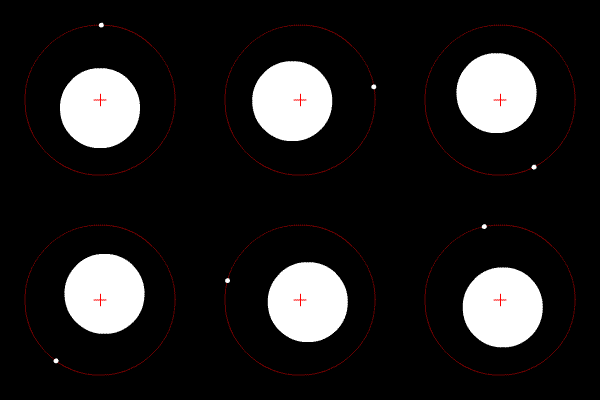
If one of the two orbiting bodies is much more massive than the other and the bodies are relatively close to one another, the barycenter will typically be located within the more massive object. In this case, rather than the two bodies appearing to orbit a point between them, the less massive body will appear to orbit about the more massive body, while the more massive body might be observed to wobble slightly. This is the case for the Earth–Moon system, in which the barycenter is located on average 4,671 km (2,902 mi) from Earth's center, 75% of Earth's radius of 6,378 km (3,963 mi). When the two bodies are of similar masses, the barycenter will generally be located between them and both bodies will orbit around it. This is the case for Pluto and Charon, one of Pluto's natural satellites, as well as for many binary asteroids and binary stars. When the less massive object is far away, the barycenter can be located outside the more massive object. This is the case for Jupiter and the Sun; despite the Sun being a thousandfold more massive than Jupiter, their barycenter is slightly outside the Sun due to the relatively large distance between them.[2]
In astronomy, barycentric coordinates are non-rotating coordinates with the origin at the barycenter of two or more bodies. The International Celestial Reference System (ICRS) is a barycentric coordinate system centered on the Solar System's barycenter.
Two-body problem

The barycenter is one of the foci of the elliptical orbit of each body. This is an important concept in the fields of astronomy and astrophysics. If a is the semi-major axis of the system, r1 is the semi-major axis of the primary's orbit around the barycenter, and r2 = a − r1 is the semi-major axis of the secondary's orbit. When the barycenter is located within the more massive body, that body will appear to "wobble" rather than to follow a discernible orbit. In a simple two-body case, the distance from the center of the primary to the barycenter, r1, is given by:
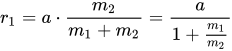
where :
- r1 is the distance from body 1 to the barycenter
- a is the distance between the centers of the two bodies
- m1 and m2 are the masses of the two bodies.
Primary–secondary examples
The following table sets out some examples from the Solar System. Figures are given rounded to three significant figures. The terms "primary" and "secondary" are used to distinguish between involved participants, with the larger being the primary and the smaller being the secondary.
- m1 is the mass of the primary in Earth masses (M⊕)
- m2 is the mass of the secondary in Earth masses (M⊕)
- a (km) is the average orbital distance between the two bodies
- r1 (km) is the distance from the center of the primary to the barycenter
- R1 (km) is the radius of the primary
- r1R1 a value less than one means the barycenter lies inside the primary
- A The Earth has a perceptible "wobble". Also see tides.
- B Pluto and Charon are sometimes considered a binary system because their barycenter does not lie within either body.[3]
- C The Sun's wobble is barely perceptible.
- D The Sun orbits a barycenter just above its surface.[4]
Inside or outside the Sun?

If m1 ≫ m2 — which is true for the Sun and any planet — then the ratio r1R1 approximates to:

Hence, the barycenter of the Sun–planet system will lie outside the Sun only if:

—that is, where the planet is massive and far from the Sun.
If Jupiter had Mercury's orbit (57,900,000 km, 0.387 AU), the Sun–Jupiter barycenter would be approximately 55,000 km from the center of the Sun (r1R1 ≈ 0.08). But even if the Earth had Eris' orbit (1.02×10¹⁰ km, 68 AU), the Sun–Earth barycenter would still be within the Sun (just over 30,000 km from the center).
To calculate the actual motion of the Sun, only the motions of the four giant planets (Jupiter, Saturn, Uranus, Neptune) need to be considered. The contributions of all other planets, dwarf planets, etc. are negligible. If the four giant planets were on a straight line on the same side of the Sun, the combined center of mass would lie about 1.17 solar radii or just over 810,000 km above the Sun's surface.[5]
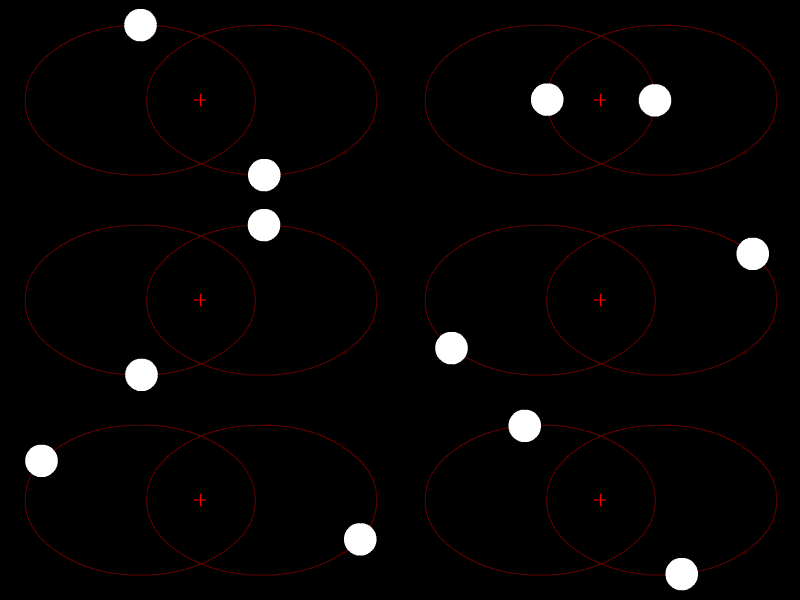
The calculations above are based on the mean distance between the bodies and yield the mean value r1. But all celestial orbits are elliptical, and the distance between the bodies varies between the apses, depending on the eccentricity, e. Hence, the position of the barycenter varies too, and it is possible in some systems for the barycenter to be sometimes inside and sometimes outside the more massive body. This occurs where
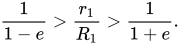
The Sun–Jupiter system, with eJupiter = 0.0484, just fails to qualify: 1.05 < 1.07 > 0.954.
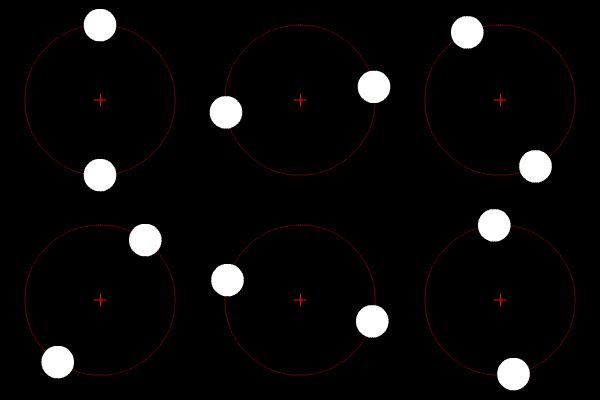
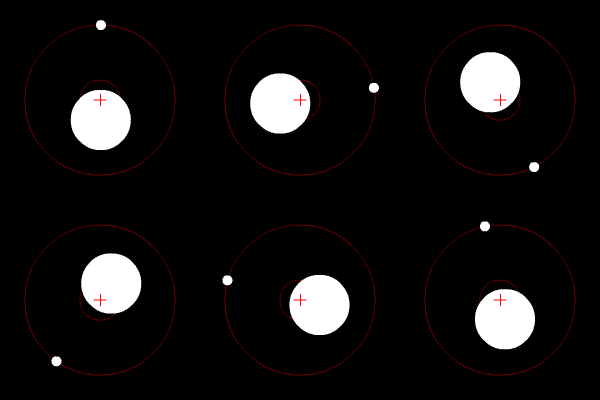
Gallery
Images are representative (made by hand), not simulated.



Relativistic corrections
In classical mechanics, this definition simplifies calculations and introduces no known problems. In general relativity, problems arise because, while it is possible, within reasonable approximations, to define the barycenter, the associated coordinate system does not fully reflect the inequality of clock rates at different locations. Brumberg explains how to set up barycentric coordinates in general relativity.[6]
The coordinate systems involve a world-time, i.e. a global time coordinate that could be set up by telemetry. Individual clocks of similar construction will not agree with this standard, because they are subject to differing gravitational potentials or move at various velocities, so the world-time must be synchronized with some ideal clock that is assumed to be very far from the whole self-gravitating system. This time standard is called Barycentric Coordinate Time, or TCB.
Selected barycentric orbital elements
Barycentric osculating orbital elements for some objects in the Solar System are as follows:[7]
For objects at such high eccentricity, barycentric coordinates are more stable than heliocentric coordinates.
| This article uses material from the Wikipedia article Metasyntactic variable, which is released under the Creative Commons Attribution-ShareAlike 3.0 Unported License. |